
VoS NEWS DESK | NEW YORK | 25 NOVEMBER 2026
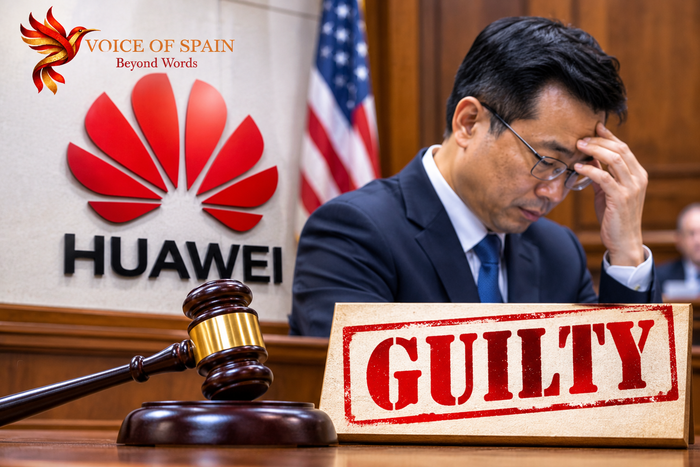
Chinese telecommunications giant Huawei Technologies and three of its subsidiaries have been found guilty of multiple criminal offences by a federal jury in the United States, following a lengthy trial involving allegations of trade secrets theft, financial fraud and violations of American sanctions against Iran. The verdict represents a significant development in the continuing legal and technological tensions between Washington and Beijing.
The decision was announced on 24 November 2026 after a 12-week trial before a federal court in Brooklyn, New York. The jury found Huawei and its subsidiaries guilty of several offences, including conspiracy to steal trade secrets, bank fraud, wire fraud, conspiracy to defraud the United States and violations of the International Emergency Economic Powers Act. The case also involved allegations of money laundering and efforts to conceal the company's business activities connected to Iran.
According to the US Department of Justice, prosecutors presented evidence that Huawei had engaged in a prolonged effort to obtain confidential technology and intellectual property belonging to American companies. The evidence included allegations involving T-Mobile's testing robot, known as Tappy, which was designed to assess touchscreen responsiveness. Prosecutors argued that Huawei employees obtained confidential information and technical details about the equipment despite contractual restrictions.
The trial also examined allegations involving proprietary technology from other American businesses, including Cisco and technology company CNEX. Prosecutors maintained that confidential source code, hardware information and technical documentation had been obtained through improper means to strengthen Huawei's competitive position.
Another central element of the case concerned Huawei's business activities in Iran. US prosecutors alleged that the company used an entity known as Skycom to conduct business while misleading financial institutions and American authorities about its relationship with the organisation. According to the prosecution, these representations helped Huawei maintain access to international banking services and obtain substantial financial support.
However, the verdict was not a complete victory for prosecutors. The jury acquitted Huawei of the more serious charge of criminal racketeering conspiracy, distinguishing that allegation from the other offences for which the company was convicted.
The financial consequences could be substantial. Huawei and the subsidiaries involved face possible criminal fines, forfeiture and restitution. Sentencing has been scheduled for 14 September 2027, when the federal court will determine the penalties.
The case has attracted considerable international attention because Huawei remains one of the world's most influential telecommunications equipment manufacturers. Its legal difficulties in the United States could have wider implications for international technology competition, intellectual property protection and commercial relations between major economies.
VoS STRATEGIC INSIGHT
The Huawei verdict highlights the growing importance of intellectual property protection, financial transparency and national security in international technology markets. The case also demonstrates how legal disputes involving major multinational corporations can influence diplomatic relations and global business confidence. Although Huawei's acquittal on the racketeering charge represents an important distinction, the remaining convictions could create further challenges for the company's international operations and relationships with Western markets.