
VoS NEWS DESK | ISLAMABAD | 12 NOVEMBER 2026
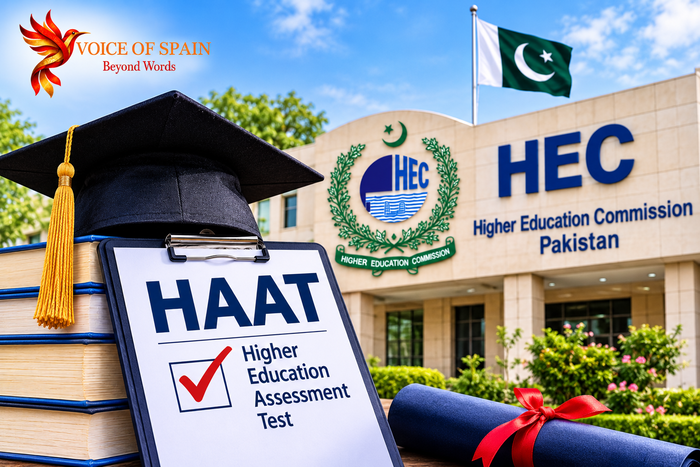
Pakistan's Higher Education Commission (HEC) has announced a major change to the country's doctoral admission process by introducing the Higher Education Aptitude and Achievement Test (HAAT) as a mandatory requirement for PhD admissions across public and private universities. The initiative aims to establish a standardised national assessment framework, improve transparency in postgraduate selection and strengthen academic standards within Pakistan's higher education sector.
The new examination is being developed through HEC's Education Testing Council (ETC), which is working with university representatives, academic specialists and subject experts to prepare discipline-specific assessments. The introduction of HAAT represents an effort to establish a common benchmark for evaluating candidates seeking admission to doctoral programmes, reducing differences in assessment procedures between individual universities.
According to the HEC, the first phase of the development process has resulted in the finalisation of assessment designs for 48 PhD disciplines. The development work involved more than 250 academics, subject specialists and university representatives from 81 public and private universities across Pakistan. The participating experts reviewed the proposed examination structures, subject requirements and assessment specifications to ensure that the test reflects the academic expectations of doctoral-level education.
The Education Testing Council has also established subject committees covering 89 disciplines to develop the national assessment framework. These committees are responsible for preparing examination structures that reflect the specific knowledge and research requirements of different academic fields. The remaining disciplines are expected to be incorporated as the development process progresses.
HEC Chairman Professor Dr Niaz Ahmad Akhtar has emphasised the importance of establishing a transparent, merit-based and uniform assessment system for graduate admissions. The commission considers standardised testing an important mechanism for identifying academically capable candidates and strengthening the quality of research across Pakistani universities.
The initiative also reflects growing attention towards research development, academic accountability and the international competitiveness of Pakistan's higher education institutions. A consistent admission assessment framework could help universities evaluate doctoral applicants through more comparable standards while maintaining subject-specific academic requirements.
However, the implementation of HAAT will require effective coordination between universities, examination authorities and academic departments. Prospective PhD candidates will also need clear information about examination schedules, subject coverage, eligibility requirements and the transition arrangements for upcoming admission cycles.
VO S STRATEGIC INSIGHT
The introduction of HAAT represents an important development in Pakistan's higher education policy, particularly in the area of doctoral research and academic quality assurance. A nationally standardised examination could improve transparency and establish more consistent admission benchmarks across universities. Its long-term effectiveness, however, will depend on fair examination procedures, subject-specific assessment quality and equal access for candidates from different regions. If implemented effectively, HAAT could contribute to stronger research standards and a more credible doctoral education system in Pakistan.