VoS NEWS DESK | VILNIUS | 23 NOVEMBER 2026
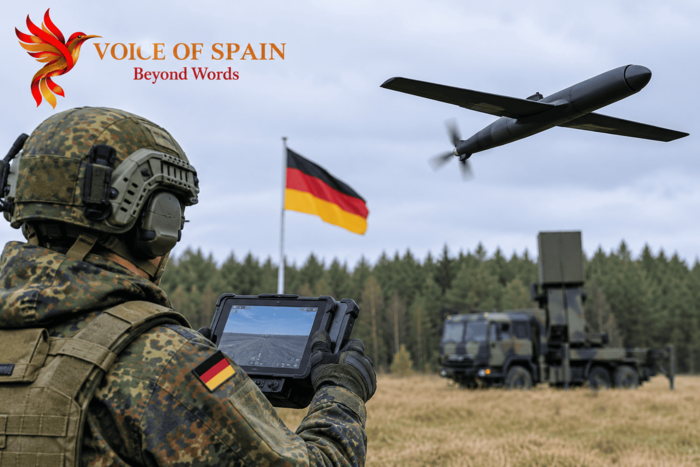
The military trials are taking place at the Rūdninkai training area in Lithuania, close to the country's border with Belarus. German forces are examining the operational capabilities of loitering munitions developed by German defence technology companies Helsing and Stark Defence. These unmanned aircraft are designed to remain airborne while identifying or awaiting potential targets before being directed towards them.
During the demonstrations, the drones were tested against simulated armoured targets using inert warheads, allowing military personnel to evaluate their performance without deploying live explosives. The exercises provide German forces with an opportunity to examine how emerging unmanned technologies could support conventional military formations, particularly in situations involving heavily protected vehicles and rapidly changing battlefield conditions.
The trials are part of Freedom Shield, a major military exercise involving approximately 3,800 personnel from eight NATO countries. The wider programme includes activities designed to improve coordination between allied forces, strengthen operational readiness and examine the effectiveness of modern military equipment in realistic conditions.
Alongside the drone demonstrations, German personnel have also been testing Clarity, an artificial intelligence-supported military intelligence and targeting platform developed by Helsing. The technology is designed to process information collected through multiple sources, including satellites, drones and other surveillance systems.
By analysing large quantities of battlefield information, the platform can help military personnel identify potential targets, understand changing operational conditions and provide commanders with information to support their decisions. The system is intended to improve the speed and efficiency of military intelligence processes, although decisions involving the use of weapons remain a critical area of human military responsibility.
The growing use of artificial intelligence in defence has become increasingly important following the war in Ukraine. Both Russian and Ukrainian forces have demonstrated how unmanned aircraft can influence battlefield operations, threaten armoured vehicles and disrupt traditional military strategies.
However, drone technology also presents significant challenges, including electronic interference, communication disruptions and increasingly sophisticated counter-drone systems. These limitations mean that military forces must continue developing effective protection and operational procedures alongside offensive capabilities.
Lithuania's Strategic Importance to NATO
Lithuania occupies an important geographical position on NATO's eastern flank, bordering Belarus and Russia's Kaliningrad region. Its location makes the country strategically significant for the alliance's wider regional defence planning.
Germany has also committed to maintaining a permanent military brigade in Lithuania, representing a major development in Berlin's defence policy. The formation, known as Panzerbrigade 45, is expected to reach full operational capability by 2027 and is planned to include approximately 5,000 military personnel and supporting civilian staff.
The deployment reflects Germany's growing responsibility for European security and its determination to strengthen NATO's presence in the Baltic region.
The latest exercises demonstrate how European militaries are increasingly combining conventional forces with artificial intelligence, unmanned aircraft and advanced surveillance technologies. The results of these trials could influence future procurement decisions and military training programmes across the alliance.
VoS STRATEGIC INSIGHT
Germany's drone and artificial intelligence trials in Lithuania reflect a broader transformation in European defence planning. Modern military preparedness increasingly depends on the integration of conventional forces, digital intelligence, unmanned systems and rapid decision-making capabilities. For NATO, strengthening its eastern flank is not simply a question of deploying additional troops but also ensuring that allied forces can respond effectively to emerging technological and security challenges. The balance between technological innovation, human oversight and regional deterrence will remain central to Europe's defence strategy in the coming years.