
VoS NEWS DESK | SPACE & TECHNOLOGY | 22 NOVEMBER 2026
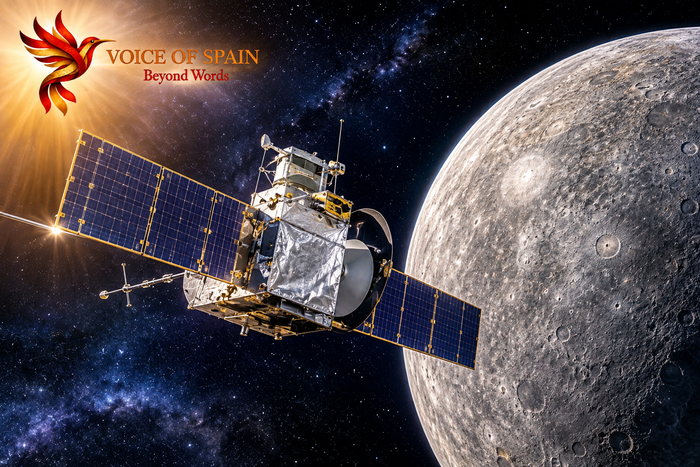
The European-Japanese BepiColombo space mission has successfully entered orbit around Mercury, marking a major achievement in planetary exploration and opening a new chapter in scientific research into the Solar System's smallest planet. The spacecraft reached its destination on 21 November 2026 after an eight-year journey through the inner Solar System, bringing together the expertise of the European Space Agency (ESA) and the Japan Aerospace Exploration Agency (JAXA).
The mission represents one of the most ambitious international space exploration projects undertaken in recent years. Launched in October 2018, BepiColombo travelled more than six billion miles, using a series of gravity-assist manoeuvres involving Earth, Venus and Mercury to adjust its trajectory and gradually approach its final destination.
The spacecraft's arrival is particularly significant because Mercury has not received a spacecraft visitor in more than a decade. The planet was last studied in orbit by NASA's MESSENGER mission, which completed its operations in 2015. BepiColombo is now expected to provide scientists with a much more detailed understanding of Mercury's physical structure, magnetic environment and geological history.
The mission consists of two scientific orbiters designed to investigate different aspects of the planet. The European Space Agency operates the Mercury Planetary Orbiter, while Japan's space agency operates the Mercury Magnetospheric Orbiter, also known as Mio. Following their arrival, the two spacecraft are scheduled to separate in December 2026 and continue towards their individual scientific orbits.
Their research will focus on several important questions, including the composition of Mercury's interior, the structure of its magnetic field, the formation of its impact craters and the geological processes that shaped its surface. Scientists are also interested in examining the planet's volcanic plains, mountainous regions and unusual surface characteristics.
Mercury presents considerable engineering challenges because of its extreme environmental conditions. Temperatures on the planet's surface can exceed 427 degrees Celsius, exposing spacecraft instruments to intense solar radiation and heat. BepiColombo has therefore been designed with specialised thermal protection systems and advanced scientific equipment to withstand the demanding conditions during its mission.
Researchers expect the mission to provide valuable scientific observations that could improve understanding of how rocky planets formed and evolved. Mercury's unusual characteristics, including its relatively large metallic core and complex magnetic environment, make it an important subject for planetary science.
The mission's major scientific phase is expected to begin in April 2027, when both orbiters will undertake their planned investigations following their separation and orbital preparations. The spacecraft are expected to operate for at least one Earth year, equivalent to four Mercury years, allowing researchers to collect extensive information about the planet.
The successful arrival also demonstrates the importance of international scientific cooperation. The partnership between ESA and JAXA has brought together technological expertise, research capabilities and resources to accomplish a mission that would be difficult for a single organisation to undertake independently.
VoS STRATEGIC INSIGHT
BepiColombo's arrival at Mercury represents more than a successful space mission; it demonstrates how international scientific partnerships can expand humanity's understanding of the universe. Its findings could help researchers understand the formation of rocky planets, the evolution of planetary magnetic fields and the conditions that shaped the early Solar System. As the scientific phase approaches in 2027, the mission is expected to deliver important discoveries that could influence future planetary exploration and space research.