
VoS NEWS DESK | CALIFORNIA | 9 NOVEMBER 2026
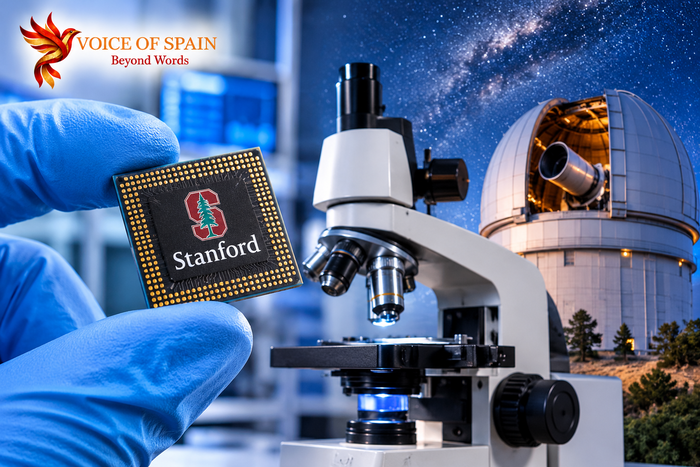
Scientists at Stanford University, working alongside international research collaborators, have developed a fingernail-sized photonic chip capable of separating complex mixtures of light into distinct beams. The breakthrough could contribute to significant advances in optical imaging, potentially improving the capabilities of microscopes, telescopes, cameras and other scientific instruments.
The research, published in the scientific journal Nature Photonics on 30 October 2026, addresses a longstanding challenge in optical science: identifying individual light contributions when multiple sources overlap. Researchers have demonstrated that a compact chip can analyse partially coherent light and separate its underlying components into independent optical beams.
Unlike conventional electronic processors, which primarily use electrical signals, photonic chips work directly with light particles known as photons. These devices use specialised optical structures to guide and process light on a very small surface. The newly developed technology combines this approach with computational algorithms to identify different coherence modes within an incoming light field.
During laboratory experiments, researchers directed infrared light from two separate lasers into the chip, creating a mixture of partially coherent light. The device analysed the incoming signals and separated them into distinct outputs. The team subsequently introduced a third laser to test whether the technology could also handle more complicated mixtures. The experiments demonstrated that the system could successfully separate the different optical components.
One of the most promising applications could be advanced microscopy. In conventional imaging, two fluorescent particles positioned close together may appear as a single object because their light signals overlap. The new photonic chip could potentially help researchers distinguish between their separate light contributions, allowing more detailed observations of microscopic structures.
Astronomy could also benefit from the development. When light travels across enormous distances from stars and other celestial objects, different sources can appear blended together when observed through telescopes. The ability to separate these signals could provide astronomers with additional information about distant astronomical objects.
Researchers David Miller, Olav Solgaard and Annie Kroo are among the Stanford scientists involved in the project. The research team is also collaborating with NASA to investigate whether the technology could help analyse light from distant galaxies and distinguish signals associated with different stellar sources.
Beyond astronomy and microscopy, the technology could eventually find applications in optical communication, scientific sensing and advanced computing. However, the current achievement represents an experimental demonstration rather than a commercially available imaging solution. Further research will be necessary to establish how effectively the technology can operate in practical environments and larger optical systems.
The development demonstrates the growing importance of photonics in modern scientific research. By processing information directly through light, researchers are exploring new ways to overcome limitations associated with conventional imaging and electronic technologies.
VoS STRATEGIC INSIGHT
The Stanford photonic chip represents an important development in the effort to extract more information from light. Its potential applications extend across scientific imaging, astronomy, healthcare research and optical communication. If future testing confirms its practical capabilities, the technology could help researchers observe microscopic structures and distant celestial objects with greater precision. The collaboration with NASA also highlights the potential importance of advanced photonics in future space exploration and astronomical research.