
VoS NEWS DESK | IMMIGRATION LAW & POLICY | 29 OCTOBER 2026
Immigration has become one of the most consequential issues in Spain’s political landscape, reflecting wider European disagreements over border management, economic needs, social integration and the rights of people who have settled in their host countries. Spain has maintained a comparatively open approach to labour migration and regularisation, arguing that legal pathways can help bring workers into the formal economy, strengthen public finances and support sectors that depend on migrant labour. Critics, however, argue that immigration levels are placing additional pressure on housing, public services and local communities.
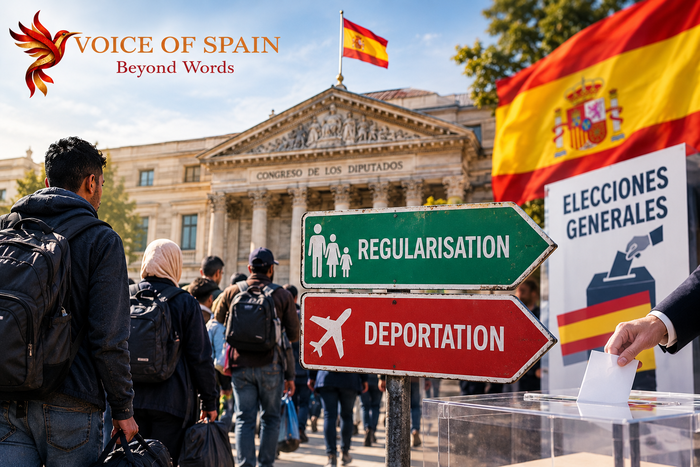
The approaching election has brought these competing arguments into sharper focus. Vox has called for a substantial reversal of Sánchez’s immigration legacy and has demanded stricter measures against irregular migration. The party’s proposals include large-scale deportations and restrictions affecting migrants’ access to welfare and public services. The Financial Times has reported that Vox could gain significant influence if the conservative People’s Party (PP) requires its support to form a government. The political outcome remains uncertain, and any proposed changes would have to be considered within Spain’s constitutional framework and its obligations under European and international law.
A central point of disagreement is Spain’s extraordinary regularisation programme. In January 2026, the Spanish government announced plans for a process intended to provide eligible foreign nationals already living in the country with an opportunity to obtain lawful residence. The government subsequently approved the measure in April. Under the published framework, applicants must meet specified conditions, including requirements relating to their presence in Spain, continuous residence and criminal records. Successful applicants can obtain an initial residence and work authorisation, subject to the applicable rules. The process does not automatically grant Spanish nationality or citizenship.
Supporters of regularisation argue that allowing eligible residents to work legally can improve labour protections and reduce exploitation. People without secure immigration status may face difficulties accessing formal employment and can become vulnerable to employers who take advantage of their circumstances. Bringing eligible workers into the legal system can help authorities enforce employment standards, improve the collection of taxes and social contributions, and give workers a clearer understanding of their rights and responsibilities.
The government has also presented regularisation as a response to an existing social and economic reality. Many migrants already live in Spanish communities, contribute to local economies and work in sectors that require substantial labour. A policy that offers a lawful route to eligible people, supporters argue, can help public authorities manage migration more effectively than leaving large numbers of residents in prolonged administrative uncertainty.
Opponents raise different concerns. They argue that broad regularisation measures may encourage further irregular arrivals, weaken immigration controls or make it harder for the state to demonstrate that entry and residence rules are being enforced. Some also point to pressures on housing availability, public infrastructure and local services, particularly in areas where population growth has been rapid. These arguments have become central to the election debate, although the scale and causes of such pressures vary across regions and cannot be attributed to immigration alone.
The dispute is therefore not simply about whether Spain should be strict or permissive. It concerns the balance between border enforcement, the needs of the labour market, the management of existing migrant populations and the protection of fundamental rights. Policymakers must consider how rules operate in practice, whether administrative systems have sufficient resources and how decisions affect employers, communities and migrants themselves.
Deportation policy is another increasingly contentious issue. The Financial Times reports that Vox’s proposals could affect not only undocumented migrants but potentially some people with lawful residence, depending on the measures pursued. Any attempt to change the legal status or remove an individual would, however, have to comply with applicable law. Immigration status, the circumstances of an individual case, procedural safeguards and the availability of legal remedies can all be relevant to the lawful handling of a case. Political campaign statements should not be mistaken for immediate changes to an individual’s rights.
The situation at Spain’s North African enclave of Ceuta has added another dimension to the national debate. On 27 October, Reuters reported that Spain had deported 16 asylum seekers from several countries to Morocco, marking the first such return since a mass border crossing in July. Spanish authorities said Morocco had agreed to receive the group and described the destination as safe under European Union standards. Rights organisations challenged the government’s position, warning that returns could expose people to mistreatment and raising concerns about the protection of asylum rights. The episode illustrates the difficult legal and humanitarian questions that arise when border enforcement intersects with applications for international protection.
For migrants already living in Spain, the political debate may understandably create uncertainty. However, an election campaign or a party’s proposal does not, by itself, cancel an existing residence permit, stop every pending application or automatically change the legal requirements for regularisation. Immigration procedures continue to depend on the rules in force, the relevant administrative authorities and the details of each person’s case. People with applications in progress should rely on official government notices and qualified immigration lawyers rather than unverified social media claims.
This distinction is particularly important for people considering applying for residence, renewing a permit, seeking family reunification or moving from an irregular to a lawful status. Requirements and deadlines can differ according to the route being used. Applicants should keep copies of relevant documents, monitor official communications and obtain advice if they receive a formal decision or request from an immigration authority. They should also be cautious about anyone promising guaranteed residence or claiming that a political announcement automatically secures legal status.
The election could influence the future direction of Spanish immigration policy, but the eventual impact will depend on the result, the formation of any governing coalition and the legal measures that are actually introduced. A change in political leadership does not automatically mean that every existing rule is immediately repealed. Any significant reform would need to be assessed through the relevant legislative and administrative processes, with attention to its compatibility with constitutional protections and Spain’s wider legal obligations.
Spain’s immigration debate also reflects a wider European challenge. Governments across the continent are under pressure to manage borders, respond to irregular migration and address public concerns, while many economies continue to rely on migrant workers. Finding a sustainable approach requires effective administration, credible enforcement, realistic legal pathways and policies that support integration. Decisions driven solely by election campaigning may fail to address the practical complexities involved.
As Spain approaches the 29 November vote, immigration is likely to remain a defining political issue. The debate will influence not only the future of regularisation and deportation policy but also the experiences of migrants, employers and communities across the country. For now, the key distinction is between proposals being promoted by political parties and immigration rules that have actually been adopted and brought into force.
VoS STRATEGIC INSIGHT
Spain’s immigration debate highlights the importance of separating political promises from enforceable law. The election may create pressure for significant policy changes, but migrants should not assume that proposed restrictions are already in force or that an existing legal status has been withdrawn.
For people living in Spain or preparing an immigration application, the most practical approach is to check current requirements through official Spanish government channels, maintain accurate documentation and seek qualified legal advice where necessary. For policymakers, the central challenge is to build a system that manages migration effectively while respecting legal safeguards, addressing labour-market needs and supporting social integration.
Source: Financial Times; Government of Spain; Reuters.