
VoS NEWS DESK | PARIS | 27 NOVEMBER 2026
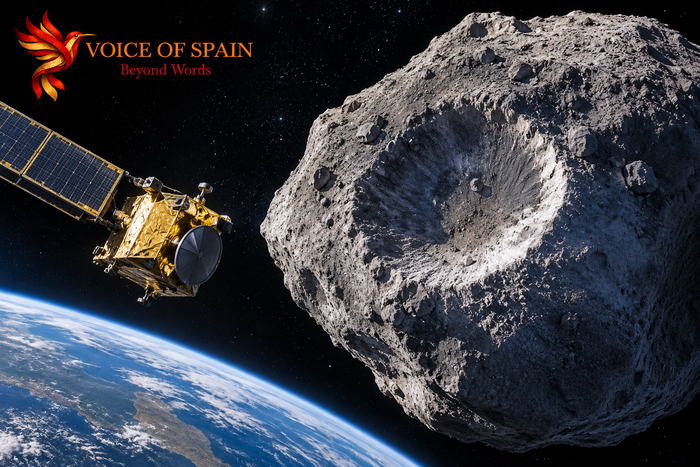
New images released by the European Space Agency (ESA) have revealed the extraordinary physical impact of NASA's Double Asteroid Redirection Test (DART) mission on the asteroid Dimorphos, showing a massive crater covering almost the entire side struck by the spacecraft in 2022. The latest observations provide scientists with a closer understanding of how a deliberate spacecraft collision can alter the physical structure and movement of a celestial object.
The images were captured by ESA's Hera spacecraft, which is examining the Didymos asteroid system to investigate the long-term consequences of NASA's planetary defence experiment. The newly released photographs show that Dimorphos has been left with a flattened surface and a stadium-sized impact crater following the collision. Scientists have also observed that the asteroid is now tumbling in a chaotic manner, with hundreds of floating boulders and pieces of debris surrounding the system.
Dimorphos is an asteroid moonlet measuring approximately 151 metres in diameter and orbiting the larger asteroid Didymos, which measures around 730 metres across. The two objects are classified as near-Earth asteroids, although scientists have confirmed that neither currently poses a threat to Earth. Their distance from our planet is approximately 193.5 million kilometres.
NASA launched the DART mission in 2021, with the spacecraft deliberately striking Dimorphos on 26 September 2022. The experiment was designed to determine whether a spacecraft could change the trajectory of an asteroid through a controlled kinetic impact. Subsequent observations confirmed that the collision successfully altered Dimorphos's orbital period around Didymos, demonstrating the potential of this technique as a future planetary defence strategy.
The latest observations are particularly important because they reveal the physical consequences of the collision in greater detail than previous measurements. Scientists had already established that the mission changed the asteroid's movement, but the new images provide additional evidence of the extensive structural damage caused by the impact. Researchers are now examining the crater, displaced material and surrounding debris to understand how the asteroid responded to the collision.
ESA's Hera spacecraft is expected to move closer to the asteroid system in December, approaching within approximately 13 kilometres to obtain higher-resolution observations. The mission will help researchers investigate the internal structure, composition and physical characteristics of both celestial objects.
The findings could contribute to the development of more effective planetary defence technologies, particularly strategies designed to protect Earth from potentially hazardous asteroids in the future.
VoS STRATEGIC INSIGHT
The latest findings from the Hera mission demonstrate how international scientific cooperation is advancing humanity's ability to understand and potentially prevent asteroid-related threats. NASA's DART experiment established that a spacecraft could successfully alter an asteroid's trajectory, while ESA's observations are helping scientists understand the physical consequences of such an intervention. Future research into asteroid composition, impact behaviour and orbital changes could become essential for developing reliable planetary defence systems. The mission also highlights the growing importance of international cooperation in space exploration and protecting Earth from potential cosmic hazards.