
VoS NEWS DESK | INTERNATIONAL SECURITY & EUROPEAN AFFAIRS | 6 NOVEMBER 2026
WARSAW: Poland's latest security operation has drawn international attention after authorities announced the detention of six people suspected of participating in an organised network allegedly supplying military-use materials to Russia. According to the Polish Internal Security Agency, investigators believe the group operated on behalf of Russian intelligence services and helped strengthen Russia's military capabilities through the illegal export of components used in ammunition and weapons manufacturing.
The investigation involves five Polish citizens aged between 25 and 52 and a 37-year-old Russian woman. Polish officials have confirmed that all six suspects face allegations of participating in an organised criminal group involved in the illegal movement of strategically important materials. Four of them have additionally been charged with espionage and placed in pre-trial detention for three months following a court decision. The other two suspects have been subjected to non-custodial preventive measures while the investigation continues.
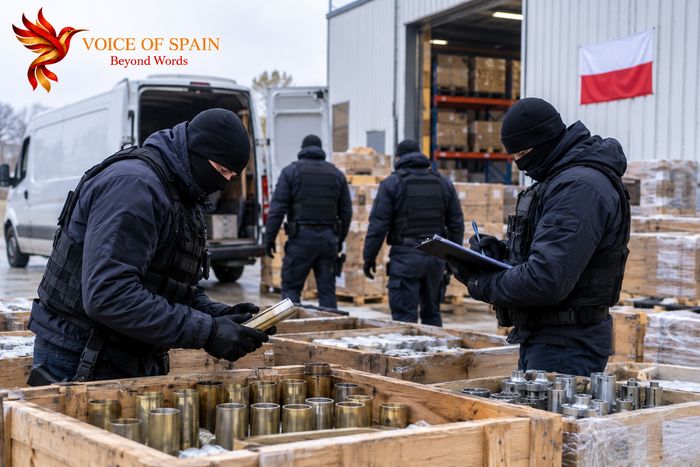
According to information released by Polish authorities, the suspected network allegedly arranged the purchase, collection and transportation of military components without the necessary authorisations. The materials reportedly included cartridge cases and projectiles, which can be used in the production of ammunition and weapons systems. Investigators believe that these supplies were intended to support Russia's military production capabilities despite restrictions and embargoes governing the export of strategically sensitive goods.
The alleged operation extended beyond Poland and involved activities connected to Lithuania and Russia. Investigators believe the group operated from at least June 2023 until December 2025. Members were reportedly responsible for purchasing the required materials, organising their collection and arranging transportation towards Russia's Kaliningrad region. The investigation suggests that the network used different methods to move the goods across borders while attempting to avoid detection by law enforcement agencies.
One of the significant aspects of the investigation concerns the alleged use of vehicles equipped with hidden compartments to transport military components. According to information provided by the Polish National Prosecutor's Office, members of the group repeatedly crossed the Polish-Russian border, while border authorities managed to intercept some shipments. The suspects also reportedly purchased certain materials through online stores before arranging their transportation.
Poland's Internal Security Agency conducted searches at 21 locations between 21 October and 2 November as part of the operation. The searches covered areas in the Warmia-Masuria, Pomerania and Greater Poland regions. The investigation is being supervised by the National Prosecutor's Office in Białystok, with security officials examining the alleged activities of the network, its international connections and the extent of the suspected illegal exports.
The financial value of the components involved has also become an important element of the investigation. According to reporting on the case, the value of the military-related materials purchased and transported illegally exceeded 2 million Polish zlotys, equivalent to approximately €455,000. Authorities are examining the full scale of the operation, including the individuals involved in procuring the materials and the methods allegedly used to transfer them across international borders.
Poland's security leadership has described the investigation as part of a wider effort to identify and prevent activities linked to foreign intelligence services. Tomasz Siemoniak, the Polish official responsible for coordinating the country's intelligence services, said the evidence indicated that the detained individuals had conducted activities on behalf of Russian special services. He also highlighted the potential consequences of supplying materials that could contribute to Russia's military production.
The latest arrests come amid continuing concerns in Poland over suspected espionage and sabotage activities. Siemoniak stated that approximately 100 people had been suspected in investigations involving espionage and sabotage since 1 January 2024. The figure reflects the scale of security investigations undertaken by Polish authorities during a period of heightened tensions between Russia and European countries.
Poland occupies a strategically important position on NATO's eastern flank and remains one of Ukraine's major supporters. Its territory serves as an important transit route for Western military and humanitarian assistance reaching Ukraine. Consequently, any suspected illegal movement of military-related materials towards Russia has wider implications for regional security, European defence cooperation and the enforcement of international export restrictions.
The investigation also highlights the challenges European security agencies face in monitoring the movement of strategically important goods. The growing use of online purchasing, international transport networks and concealed vehicle compartments can make it more difficult for authorities to identify illegal supply chains. Polish officials are continuing their investigation to establish the full extent of the alleged activities and determine whether additional individuals were involved.
The case remains under investigation, and the allegations against the suspects will be subject to the relevant judicial proceedings. The Russian Embassy had not immediately commented on the arrests, while the Kremlin has consistently denied conducting sabotage operations in NATO countries.
VoS STRATEGIC INSIGHT
Poland's latest espionage investigation highlights the growing importance of intelligence cooperation and border security across Europe. The alleged movement of military components towards Russia demonstrates that national security threats are not limited to conventional military operations or direct acts of aggression. Illegal supply networks, intelligence activities and the transfer of strategically important technologies can also create serious challenges for European security.
One of the most important aspects of this case is the alleged involvement of an international network operating across Poland, Lithuania and Russia. Such investigations demonstrate how criminal supply chains can extend across multiple jurisdictions, making cooperation between intelligence agencies, customs authorities and border-security institutions essential.
The case also highlights the importance of enforcing restrictions on the international trade of military-related materials. Even components that may appear to be ordinary industrial products can have strategic significance when used in ammunition manufacturing and weapons systems. Effective monitoring of procurement, transportation and cross-border trade is therefore an important part of preventing sensitive materials from reaching restricted destinations.
For NATO and European Union members, Poland's investigation carries wider security implications. Poland's geographical position and role in supporting Ukraine make the protection of its borders and strategic infrastructure particularly important. Continued intelligence-sharing and stronger coordination between European security institutions will remain necessary to identify potential threats before they develop into larger security incidents.
The investigation also reinforces the need for transparent judicial procedures. While national security agencies must respond firmly to suspected espionage and illegal exports, the allegations against those detained must be assessed through the established legal process.
Ultimately, the arrests underline the changing nature of European security challenges. Protecting national interests increasingly requires governments to monitor not only military movements but also intelligence networks, commercial supply chains and strategically sensitive international trade.