
VoS NEWS DESK | INTERNATIONAL SECURITY AND DEFENCE | 29 OCTOBER 2026
North Korea’s latest missile launches have once again placed the Korean Peninsula at the centre of international security concerns. The reported launches highlight the continuing military tensions between Pyongyang and Seoul, as well as the wider strategic challenges facing countries across East Asia. Although the missiles were directed towards the sea, rather than reported as strikes against land targets, their launch has prompted regional authorities to monitor developments closely and assess the potential implications for security.
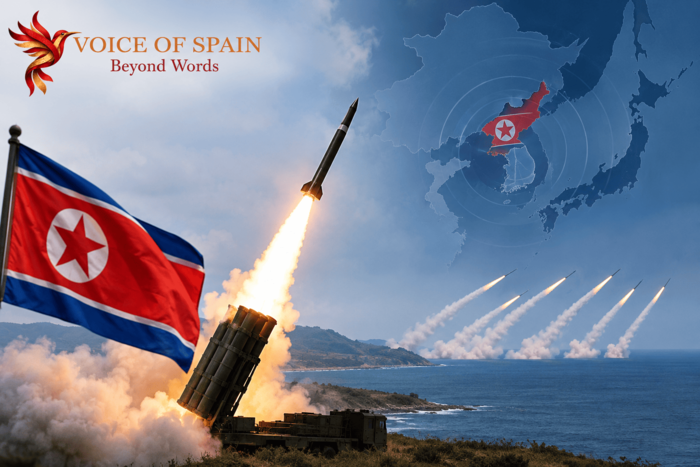
According to South Korea’s Joint Chiefs of Staff, the missiles were launched at approximately 12.30 pm local time from the Wonsan area. South Korean military authorities reported that around 10 short-range ballistic missiles were involved in the barrage. Japan also reported detecting a possible ballistic missile launch, with its authorities indicating that the projectile had fallen into the sea outside Japan’s Exclusive Economic Zone. The available reports do not indicate that the latest launches resulted in confirmed damage on land.
The incident is significant because ballistic missile launches by North Korea have long been a source of tension with neighbouring countries. Pyongyang maintains that its military capabilities are necessary for national defence, while South Korea, Japan and the United States view its weapons development as a serious challenge to regional stability. Repeated launches can increase military alert levels, intensify diplomatic disputes and create additional pressure on governments to demonstrate that they can respond effectively to potential threats.
For South Korea, the immediate priority is to monitor North Korea’s military activity and ensure that its armed forces remain prepared for any further developments. Officials said surveillance was being strengthened following the launches, while information was being shared with Washington and Tokyo. Such coordination allows the three countries to compare intelligence, assess missile activity and improve their understanding of developments that could affect their security.
The United States also has a significant role in the regional security arrangement. Washington maintains a longstanding defence partnership with South Korea and co-operates with Japan on a range of security matters. Missile launches by North Korea therefore affect not only relations between the two Koreas but also the wider strategic relationship between the United States and its allies in the Indo-Pacific region.
Japan has particular reasons to pay close attention to North Korea’s missile programme. The country relies on regional early-warning systems and military co-operation to assess potential threats from nearby waters. Even when a missile falls outside Japan’s Exclusive Economic Zone, the launch can still provide important information about North Korea’s weapons capabilities, operational readiness and military intentions.
The latest incident follows an earlier series of ballistic missile launches on 12 October. North Korea has conducted repeated weapons tests during 2026, reflecting the continuing importance its leadership places on developing and demonstrating military capabilities. Each new test provides neighbouring countries with additional information to analyse, while also contributing to concerns that the cycle of weapons development and military responses could become increasingly difficult to break.
The broader situation is complicated by continuing disagreements along the inter-Korean border. Recent tensions have included disputes over military activities and a landmine incident that injured South Korean soldiers. Seoul has blamed Pyongyang for the mine incident, while North Korea has rejected accusations and accused the South of provocation. These competing accounts illustrate the lack of trust between the two governments and the difficulty of establishing effective communication during periods of heightened military alert.
One of the main concerns for regional governments is the possibility that military activity could lead to miscalculation. When armed forces operate under heightened alert, an incident that might otherwise be contained can develop into a larger confrontation if either side misinterprets the intentions of the other. Maintaining reliable communication channels, monitoring military movements and avoiding unnecessary escalation are therefore essential elements of regional crisis management.
The missile launches also raise questions about the future of diplomacy on the Korean Peninsula. Previous efforts to improve relations have struggled to overcome disagreements over North Korea’s nuclear programme, international sanctions, military exercises and the conditions required for meaningful negotiations. Although diplomatic engagement remains an important option, progress depends on whether the parties can identify practical areas of agreement and reduce the risk of confrontation.
For South Korea, the challenge is to maintain a credible defence posture while avoiding steps that could further destabilise the situation. Japan faces a similar balancing act, seeking to protect its territory and population while working with its partners to discourage further escalation. The United States, meanwhile, must consider both the security commitments it has made to its allies and the possibility of renewed diplomatic engagement with Pyongyang.
China’s position is also important because of its longstanding relationship with North Korea and its influence in regional affairs. Any sustained reduction in tensions would benefit from broader diplomatic efforts involving the countries most directly affected. However, differences over security priorities and North Korea’s weapons programme continue to make a comprehensive agreement difficult to achieve.
The international community is likely to continue monitoring North Korea’s missile activity closely. Regional authorities will assess information about the launches, including the missiles’ characteristics and flight paths, as further details become available. Such assessments can help determine whether the launches represent a change in operational behaviour or form part of North Korea’s continuing programme of weapons testing.
For ordinary people across East Asia, the central concern is whether repeated military demonstrations will lead to greater instability or encourage renewed diplomatic efforts. Heightened tensions can influence public confidence, defence planning and regional economic sentiment, particularly when governments must devote additional resources to security preparations.
At present, the latest launches underline the persistence of military competition on the Korean Peninsula. They do not, on their own, establish that a wider conflict is imminent. Nevertheless, the incident demonstrates why regional governments continue to place significant emphasis on surveillance, defence co-operation and diplomatic channels designed to prevent misunderstandings from escalating into a crisis.
In the coming days, attention will focus on any further missile activity, the findings of South Korean and Japanese assessments, and possible responses from Washington and other regional capitals. Whether the situation remains contained will depend partly on the actions taken by the governments involved and their willingness to avoid further escalation.
VoS STRATEGIC INSIGHT
North Korea’s latest missile launches demonstrate the continuing fragility of security across East Asia. While military preparedness remains necessary for South Korea, Japan and their partners, lasting stability cannot depend on defence measures alone. Intelligence-sharing, effective crisis communication and credible diplomatic engagement are equally important in reducing the risk of miscalculation. The international community should continue to monitor North Korea’s weapons programme while supporting practical efforts to prevent regional tensions from developing into a wider confrontation.
Source: Reuters; Associated Press (AP); Free Malaysia Today.