
VoS NEWS DESK | JAMMU | 10 November 2026
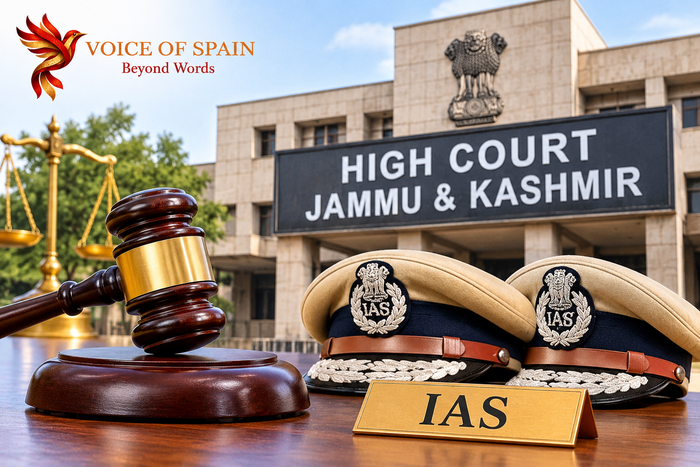
The Jammu and Kashmir and Ladakh High Court has declined an application filed by two senior Indian Administrative Service (IAS) officers in connection with the alleged multi-crore arms licence scam, bringing renewed attention to the ongoing investigation into irregularities in firearm licensing across the former state.
The application was filed by Pandurang Kondbarao Pole and Shahid Iqbal Choudhary, both senior administrative officers who are among those facing proposed prosecution proceedings following a Central Bureau of Investigation (CBI) investigation.
The officers approached the court seeking intervention in an ongoing public interest litigation and directions to the Department of Personnel and Training (DoPT), Government of India. They wanted their representations to be considered by the competent authorities before a final decision was taken on the CBI's proposal for prosecution sanction.
Their counsel, Senior Advocate Sakal Bhushan, argued that the question of prosecution sanction required an independent assessment rather than the automatic application of the doctrine of deemed sanction. The application sought to ensure that the officers' submissions were considered before the government reached its decision.
A Division Bench comprising Chief Justice Dr Pushpendra Singh Bhati and Justice Rajnesh Oswal declined to issue the requested directions. The court observed that there was no sufficient justification for requiring judicial intervention when the applicants could pursue their representations directly before the relevant government department.
Following the court's observations, the applicants' counsel sought permission to withdraw the application and pursue the matter through the appropriate administrative channels. The bench accordingly recorded that the application stood dismissed as withdrawn.
The wider arms licence investigation concerns alleged irregularities involving district magistrates, government employees and arms dealers between 2012 and 2016. According to the investigation, a large number of licences were allegedly issued in violation of established procedures, including licences obtained through forged documents and improper verification.
The CBI has sought prosecution sanction against several IAS officers in connection with the alleged irregularities. The case has attracted attention because of the scale of the licensing process and the administrative responsibilities of officials who served as district magistrates during the period under investigation.
During the proceedings, the court was also informed that the Ministry of Home Affairs had completed its examination of the matter after consulting the investigating agency and the Jammu and Kashmir government. Its considered opinion had subsequently been forwarded to the DoPT for a final decision in accordance with the applicable procedure.
The High Court has directed the Deputy Solicitor General of India, Vishal Sharma, to submit a comprehensive report concerning compliance with previous judicial orders. The public interest litigation and connected matters have been scheduled for further consideration on 23 December 2026.
Importantly, the withdrawal of the officers' application does not establish criminal liability or amount to a determination of guilt. The allegations remain subject to the relevant investigative and legal processes.
VoS STRATEGIC INSIGHT
The Jammu and Kashmir arms licence case highlights the importance of transparency, institutional accountability and consistent legal procedures within public administration.
Prosecution decisions involving senior government officials require careful consideration of evidence, statutory requirements and individual representations. The distinction between allegations, administrative decisions and established criminal liability is essential to maintaining public confidence in the justice system.
The next stage of the proceedings will be important in determining how the government responds to the pending prosecution proposals and how effectively earlier judicial directions are implemented.