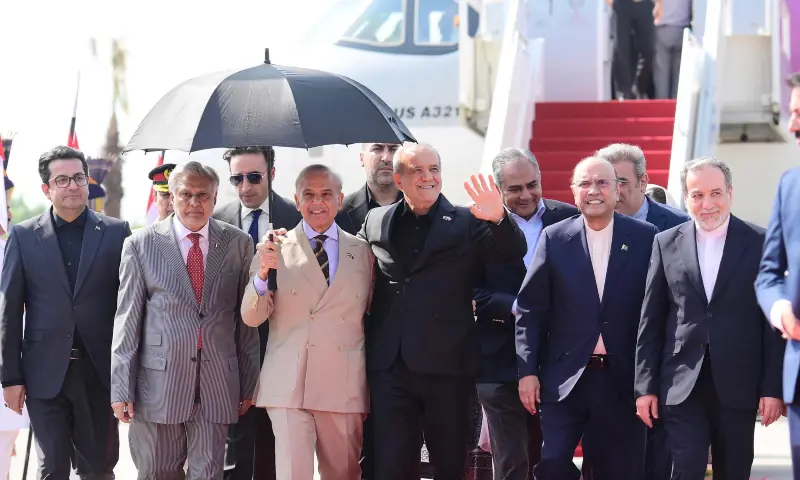
Iranian President Masoud Pezeshkian has arrived in Pakistan for an official state visit, marking his first overseas trip since the commencement of military hostilities between the United States and Israel against Iran in late February 2026. The Iranian leader was received at a military base near Islamabad by Pakistani President Asif Ali Zardari, Prime Minister Shehbaz Sharif, and Deputy Prime Minister and Foreign Minister Ishaq Dar. Pezeshkian arrived aboard a special aircraft named Minab 168, a symbolic tribute to the 168 individuals killed in an attack on an Iranian girls' school in the city of Minab during the opening day of the conflict. The Iranian delegation accompanying the president includes Foreign Minister Abbas Araghchi and numerous senior government officials, reflecting the high-level significance of the visit. During his day-long visit, Pezeshkian is scheduled to hold bilateral talks with Prime Minister Sharif and is expected to meet with President Zardari, with additional meetings planned with Senate Chairman Yousaf Raza Gilani, National Assembly Speaker Ayaz Sadiq, and other senior Pakistani officials.
The visit represents an expression of gratitude for Pakistan's pivotal role in mediating the breakthrough negotiations between the United States and Iran that concluded in Switzerland. Pakistan and Qatar jointly facilitated the crucial first round of talks held in the Swiss resort of Bürgenstock, which resulted in the signing of the Islamabad Memorandum of Understanding on June 18. During the visit, both nations are expected to review the comprehensive spectrum of bilateral relations and explore new opportunities to deepen cooperation across diverse sectors including trade, energy, border security, people-to-people exchanges, and regional connectivity. The discussions will also provide an important platform to address ongoing diplomatic engagements following the signing of the Islamabad MoU and to examine regional and international developments of mutual interest. Pakistan's Foreign Office emphasized that the visit reflects the shared commitment of both nations to strengthen their historic and cultural ties and underscores their common aspiration for peace, stability, and sustainable progress throughout the region. The visit also provides an opportunity to discuss the implications of the US-Iran peace framework for regional stability and to coordinate positions on critical issues affecting South Asia and the broader Middle East.
.png)
.png)
.png)
.png)
.png)
.png)

.png)