VoS NEWS DESK | EDUCATION & UNIVERSITIES | 29 OCTOBER 2026
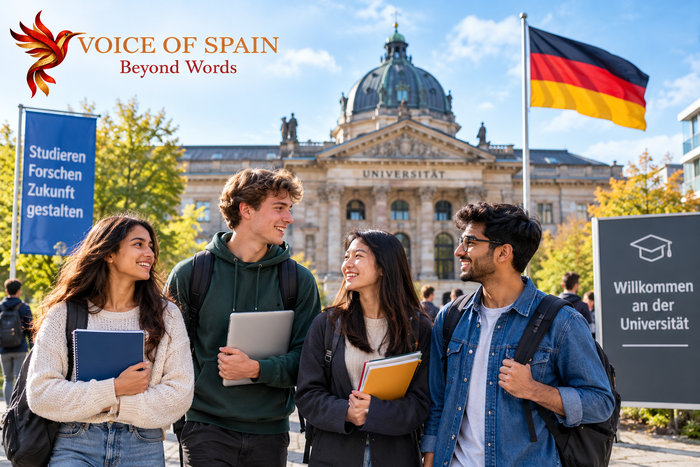
Germany’s rising international student population reflects a wider transformation in the global education landscape, as students increasingly compare countries according to affordability, academic quality, employment opportunities and the possibility of building a long-term career after graduation. While traditional destinations such as the United States, the United Kingdom, Canada and Australia continue to attract substantial numbers of overseas students, Germany has emerged as a particularly important option for those looking for strong academic programmes and access to Europe’s wider labour market.
The latest figures indicate that German universities remain attractive to students from a broad range of countries. India has become the leading country of origin, with approximately 69,000 Indian students, followed by China with around 39,000. These numbers underline the importance of international mobility to German universities and demonstrate how Asian students are contributing to the increasingly international character of higher education across Europe.
One of Germany’s strongest attractions is its established reputation in engineering, technology, natural sciences and research. The country’s universities and technical institutions have longstanding connections with industry, giving students opportunities to combine academic learning with practical knowledge. For students interested in mechanical engineering, automotive technology, computer science, renewable energy, advanced manufacturing and scientific research, Germany offers an education environment closely connected to major industrial and technological sectors.
The country’s position as a European industrial powerhouse also contributes to its appeal. Germany is home to internationally recognised companies and research organisations operating across automotive manufacturing, chemicals, pharmaceuticals, engineering and information technology. This environment can be particularly valuable for students whose ambitions extend beyond obtaining a degree and include professional experience, research collaboration or future employment.
However, international students must assess the full cost and requirements of studying abroad rather than relying on a country’s reputation alone. Although many public universities offer comparatively affordable tuition arrangements, students may still need to budget for accommodation, food, transport, health insurance, administrative costs and other living expenses. The availability of affordable housing can vary considerably between cities, and securing accommodation may be challenging in university centres with strong demand.
Language is another important consideration. Some German universities offer degree programmes taught in English, particularly at postgraduate level, but many undergraduate courses require German-language proficiency. Even students enrolled in English-taught programmes may find that learning German improves their everyday experience and broadens their access to internships, professional networks and employment opportunities. Prospective applicants should therefore check the language requirements of their chosen course before making financial or academic commitments.
Germany’s record international enrolment also presents responsibilities for universities and policymakers. Institutions must ensure that growing student numbers are matched by sufficient academic support, accommodation, administrative services and opportunities to participate fully in university life. International students need clear information about applications, qualifications, visa requirements, finances and the transition from education into employment. Without effective support, a growing international student population can place pressure on both students and institutions.
The figures also highlight the importance of international education to Germany itself. Overseas students contribute to university research, cultural exchange and local economies. Those who remain after graduation may also help address skills shortages in sectors requiring highly qualified workers. However, retaining international graduates depends on more than the quality of their degrees: employment opportunities, language skills, workplace integration and clear immigration procedures can all influence whether graduates decide to build their futures in Germany.
For students from Pakistan and other South Asian countries, Germany may be worth considering alongside more traditional study destinations. Nevertheless, applicants should research individual universities, confirm admission and language criteria, calculate realistic living costs and use official university and government information when checking immigration procedures. No destination guarantees admission, a visa or employment simply because international enrolment is increasing.
Germany’s latest student figures therefore represent more than a statistical milestone. They demonstrate that international higher education remains highly competitive, with students increasingly looking for a combination of academic quality, financial practicality and credible career pathways. The challenge for Germany will be to sustain that interest while ensuring that international students receive the resources and opportunities needed to succeed.
VoS STRATEGIC INSIGHT
Germany’s record enrolment strengthens its position in the international education market, but long-term success will depend on how effectively universities turn rising interest into positive student outcomes. Affordable education, suitable accommodation, accessible language training and meaningful career opportunities are likely to remain decisive factors for future applicants.
For international students, the central lesson is to look beyond headline enrolment figures. Choosing a university should involve comparing course quality, total costs, language requirements, scholarship options and realistic employment pathways. A well-researched decision can help students make better use of international education and avoid costly misunderstandings.
Source: Education Post, reporting on DAAD and DZHW figures.