VoS NEWS DESK | INTERNATIONAL BUSINESS & ENERGY | 5 NOVEMBER 2026
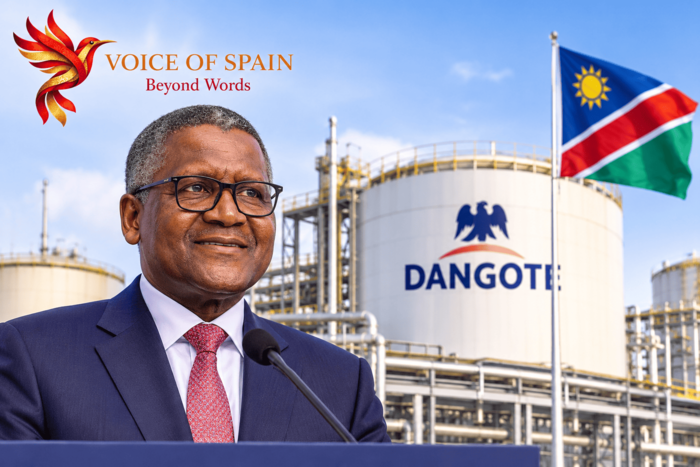
Nigerian businessman Aliko Dangote officially launched the $2.5 billion energy infrastructure project in Walvis Bay, Namibia, on 4 November 2026. The launch ceremony was attended by Namibian President Netumbo Nandi-Ndaitwah, highlighting the importance of the investment for the country's economic development and its wider regional ambitions. The project forms part of Dangote's expanding energy business across Africa and is intended to establish a stronger fuel storage and distribution system capable of serving multiple countries.
According to Reuters, the project will include a large fuel storage terminal with a planned capacity of approximately 600 million litres, equivalent to around four million barrels. Of this total capacity, approximately 360 million litres will be allocated to diesel, while the remaining storage space will accommodate petrol. Once completed, the facility will have around eight times the capacity of Namibia's existing National Oil Storage Facility, which has a storage capacity of approximately 75 million litres and is operated by the country's national oil company, Namcor.
The new infrastructure is expected to address several longstanding challenges affecting fuel distribution across the region, including high transportation costs, shipping delays and vulnerabilities in international supply chains. Namibia and several neighbouring countries depend significantly on imported petroleum products, making reliable storage facilities and efficient transportation networks particularly important. By increasing the availability of stored fuel and improving regional distribution, the project could help reduce logistical difficulties and strengthen the stability of energy supplies.
One of the most important elements of the initiative is the proposed 1,700-kilometre regional pipeline network. The planned system is expected to connect Walvis Bay with inland markets, including Botswana, Zimbabwe and Zambia, with a possible extension towards the Democratic Republic of the Congo. This network could provide landlocked countries with improved access to fuel supplies through Namibia's Atlantic coastline, creating new opportunities for regional trade and economic cooperation.
Dangote stated that the project would be completed within approximately 18 to 20 months. He also emphasised that the investment was intended to reduce logistical vulnerabilities, lower shipping-related costs and address energy insecurity. The development is expected to strengthen Walvis Bay's position as a strategic fuel distribution centre and provide a more efficient route for supplying petroleum products to markets across Southern Africa.
The investment also reflects Dangote's broader ambition to expand his influence in Africa's energy sector. He already operates Nigeria's 700,000-barrel-per-day refinery, regarded as Africa's largest, and is pursuing further expansion of his energy operations. His wider investment strategy includes plans for another major refinery in Kenya, potentially strengthening fuel production and distribution networks across both western and eastern parts of the continent.
The Namibian government is also expected to benefit from employment opportunities, infrastructure development and increased commercial activity associated with the project. The investment could encourage additional private-sector participation in the country's energy and logistics industries, while strengthening Namibia's position as a gateway for trade between coastal and landlocked African economies.
VoS STRATEGIC INSIGHT
The launch of Dangote's $2.5 billion energy project represents an important development in Africa's efforts to strengthen regional energy independence. For many landlocked countries, access to reliable fuel supplies remains dependent on complicated international transportation arrangements, expensive shipping routes and limited storage infrastructure. The proposed Namibian facility and pipeline network could help address these challenges by creating a more integrated regional distribution system.
The project also demonstrates how large-scale private investment can contribute to infrastructure development beyond national borders. Rather than focusing exclusively on domestic fuel markets, Dangote's initiative aims to connect several African economies through shared energy infrastructure. If successfully implemented, this approach could improve regional trade, strengthen supply-chain resilience and create new commercial opportunities.
However, the project's long-term success will depend on effective implementation, financing, regulatory cooperation and agreements between participating countries. The proposed pipeline network will require coordination across national borders, while the growing global transition towards renewable energy could influence long-term demand for petroleum products.
For Namibia, the investment offers an opportunity to expand its role in regional commerce and energy distribution. For Southern Africa more broadly, it could represent a significant step towards improving fuel accessibility, reducing logistical costs and building stronger economic connections between neighbouring countries.