
VoS NEWS DESK | SCIENCE & TECHNOLOGY | 12 September 2026
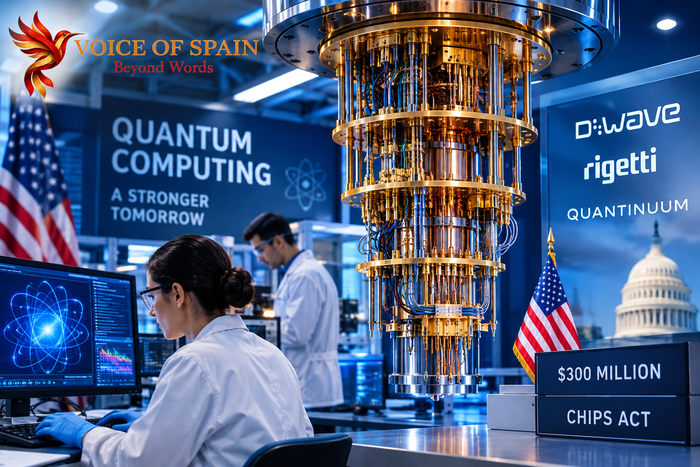
The funding will be divided equally between D-Wave Quantum, Rigetti Computing and Quantinuum, with each company receiving $100 million in research and development support. In return, the US Department of Commerce will take minority equity stakes in the three companies, giving Washington a direct financial interest in their development while supporting domestic advanced-hardware and semiconductor supply chains.
The announcement comes as governments and technology companies increasingly view quantum computing as a strategic technology. Unlike conventional computers, quantum machines use qubits, which can exploit quantum effects such as superposition and entanglement to tackle certain complex calculations in fundamentally different ways. Researchers believe the technology could eventually transform areas including pharmaceuticals, materials science, logistics, financial modelling and cybersecurity.
For Rigetti Computing, the new funding is expected to help address technical challenges involved in scaling superconducting quantum processors. The company also plans to expand cryogenic capabilities and increase manufacturing capacity, two areas considered crucial for developing larger and more reliable quantum systems.
D-Wave Quantum will focus part of its funding on advanced semiconductor prototyping and the development of scalable quantum hardware. Meanwhile, Quantinuum plans to work on integrated photonics technology and domestic manufacturing partnerships, including cooperation with GlobalFoundries and Monarch Quantum.
The wider US strategy also includes strengthening the manufacturing infrastructure needed to turn experimental quantum technology into commercial products. GlobalFoundries has separately secured a $375 million government agreement aimed at expanding domestic quantum manufacturing capabilities and helping move quantum hardware from laboratory prototypes towards larger-scale production.
The financial markets reacted positively to the announcement. Shares of Quantinuum, D-Wave and Rigetti all climbed following news of the government investment, reflecting investor expectations that public funding could accelerate development in a sector that has traditionally required enormous amounts of capital and specialised infrastructure.
However, significant scientific and engineering challenges remain. Quantum computers are extremely sensitive to environmental disturbances, which can introduce errors into calculations. Researchers therefore need to increase the number of usable qubits while simultaneously improving reliability and error correction. The industry remains divided over which technical approach will ultimately deliver commercially useful, large-scale machines.
VoS STRATEGIC INSIGHT
The latest US investment signals that quantum computing is no longer being treated solely as a long-term scientific experiment. Washington increasingly sees it as part of the country's technological and economic security, particularly as nations compete for leadership in advanced computing.
If these investments succeed, quantum technology could become an important component of future scientific research, industrial innovation and national security. But the path from promising laboratory demonstrations to practical, fault-tolerant quantum computers remains technically difficult—and the next several years will be crucial in determining which companies and countries emerge as leaders.
Source: The Wall Street Journal • Reuters