
VoS NEWS DESK | INTERNATIONAL SECURITY & ANTI-DRUG OPERATIONS | 5 NOVEMBER 2026
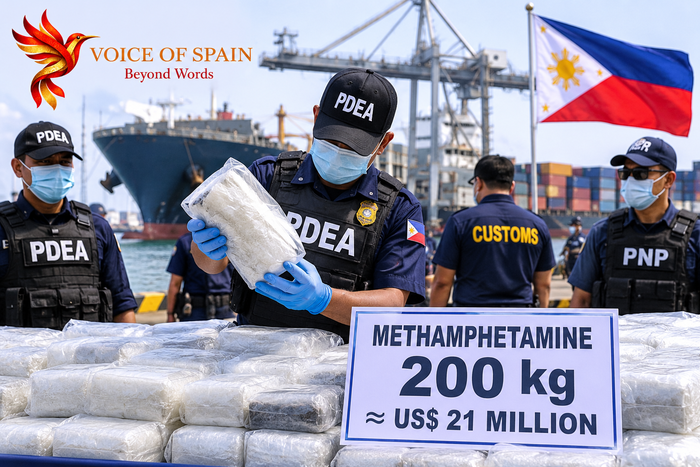
Philippine law enforcement authorities announced on 4 November 2026 that approximately 200 kilograms of methamphetamine hydrochloride had been intercepted at the Manila International Container Port in North Harbor, Manila. The operation involved the Philippine Drug Enforcement Agency (PDEA), the Bureau of Customs (BOC) and the Philippine National Police (PNP), which worked together to identify and investigate a suspicious shipment believed to be connected to an international drug trafficking network.
According to the Philippine Drug Enforcement Agency, the seized narcotics were concealed in 200 vacuum-sealed plastic bags packed inside 50 cardboard boxes. The drugs were estimated to be worth approximately 1.36 billion pesos, or around $21 million. Authorities described the interception as a significant achievement in the country's continuing efforts to prevent illegal narcotics from entering domestic markets through international shipping facilities.
Investigators revealed that the shipment originated from Laos before passing through international transportation routes. Information received from foreign law enforcement counterparts in September 2026 alerted Philippine authorities to a suspected consignment of illegal drugs destined for the country. The intelligence enabled the PDEA to coordinate with customs officials and other security agencies to monitor the shipment and identify the container involved.
The container arrived at Manila North Harbor on 6 October 2026. Following its arrival, authorities subjected it to several inspection procedures, including X-ray scanning, examination by drug-detection dogs and chemical testing using a Raman spectrometer. These procedures produced positive results for methamphetamine hydrochloride, confirming suspicions that the shipment contained illegal narcotics.
Despite the initial findings, the container remained unclaimed for a period of time. Under the prescribed legal and customs procedures, the shipment subsequently underwent abandonment proceedings before authorities opened the cargo and discovered the concealed drugs. The operation demonstrated the importance of intelligence-led inspections and coordinated investigations in identifying suspicious consignments moving through major international ports.
The Philippine authorities have also highlighted the importance of tracing the entire trafficking network rather than limiting investigations to the seizure itself. The PDEA is conducting backtracking investigations to identify the intended recipient, consignee and individuals who may have organised or financed the attempted smuggling operation. Officials are seeking to establish how the shipment was arranged and whether other individuals or criminal organisations were involved.
The operation comes amid heightened regional concerns over the movement of illegal narcotics across Southeast Asia. Laos has increasingly featured in regional anti-drug investigations as a transit point for methamphetamine trafficking. In a related development, authorities in Laos previously intercepted another shipment involving approximately 521 kilograms of suspected methamphetamine at Luang Prabang airport, reportedly destined for the Philippines. These incidents underline the scale of the challenge facing regional law enforcement agencies.
The latest seizure also demonstrates the importance of cooperation between customs authorities, national police forces and international anti-narcotics agencies. Criminal networks frequently exploit commercial shipping systems and complicated transportation routes to conceal illegal substances among legitimate cargo. Strengthening information-sharing arrangements and improving inspection capabilities have therefore become essential elements of efforts to prevent cross-border drug trafficking.
VoS STRATEGIC INSIGHT
The seizure of approximately 200 kilograms of methamphetamine at Manila Port represents a significant development in the Philippines' ongoing campaign against international drug trafficking. The estimated value of the confiscated narcotics highlights the financial scale of illegal drug operations and the economic incentives driving criminal organisations to exploit international transportation networks.
One of the most important aspects of this operation is the role of international intelligence-sharing. Information received from foreign counterparts enabled Philippine authorities to identify a suspicious shipment and coordinate inspections before the cargo could enter illegal distribution channels. This demonstrates that effective action against transnational organised crime requires cooperation between countries rather than isolated national enforcement measures.
The incident also highlights the growing importance of maritime security. Major commercial ports handle enormous volumes of international cargo, making it essential for customs authorities to maintain effective screening systems, advanced detection equipment and reliable intelligence networks. Strengthening these measures could help prevent criminal groups from using legitimate international trade routes to transport illegal substances.
For the Philippines, identifying the individuals responsible for organising the shipment will be an important next step. Recovering illegal drugs prevents their distribution, but tracing the financial networks, suppliers and intended recipients is equally important to dismantling the organisations behind such operations.
At the regional level, the case reinforces the need for stronger cooperation among Southeast Asian countries, particularly in intelligence-sharing, border monitoring and coordinated anti-narcotics investigations. Continued collaboration could help reduce trafficking activities and improve security across international maritime routes.